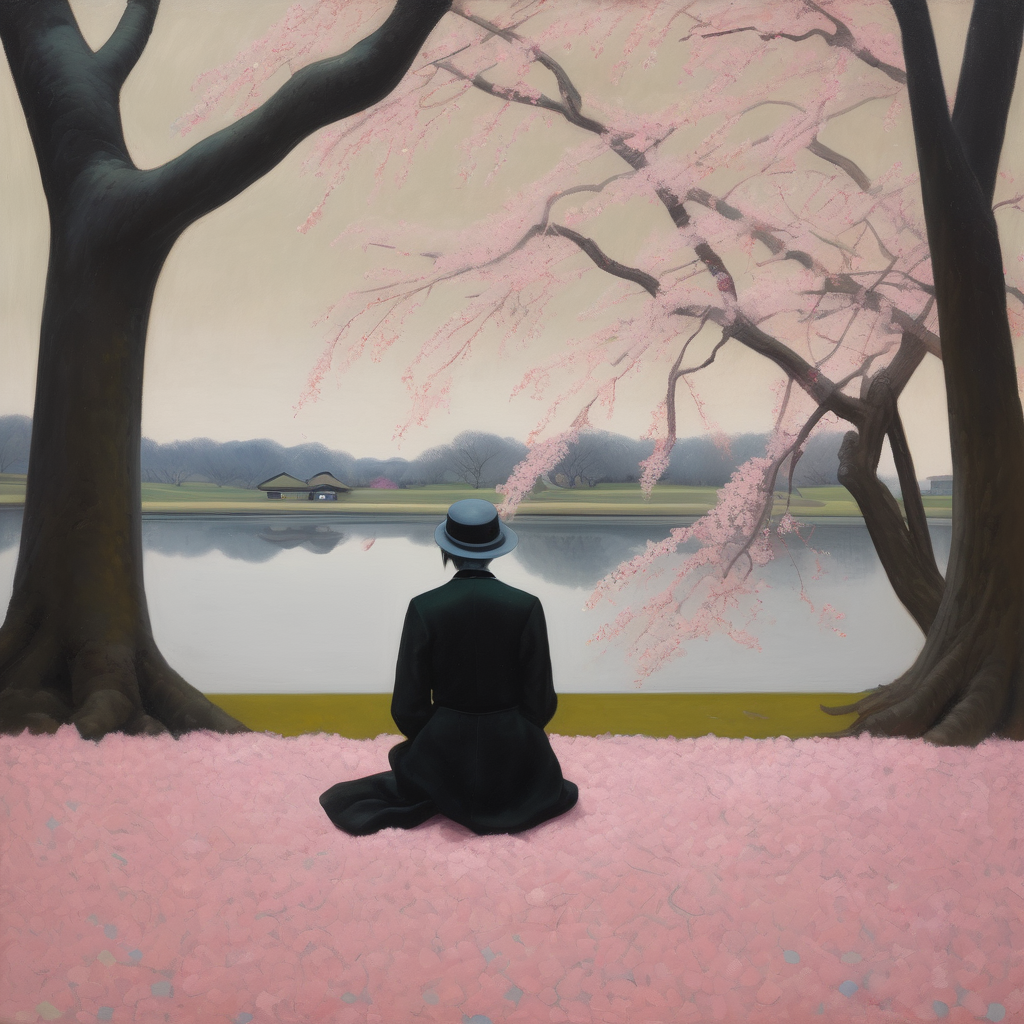
On Old Age and Closing Doors
Sometimes, when we dread something, it is not the thing itself that we dread, but the prospect of a shrunken future. What hopes and dreams might I lose? What doors will, should this thing happen, be forever shut on me? So many of our anxieties, our panics and our midnight terrors, hinge on that.
Sometimes a door closes violently. A marriage ends, and all visions for a shared future, growing old beside that person, watching children become adults together, the private jokes that were supposed to last decades, dissolve like a mirage. A parent dies before the relationship was repaired, and the conversation that might do something will now never take place; the image of a fully healed and reconciled family, even if it was only a faint hope before, is forever killed.
But the truth is, doors have always been gradually closing on us as time slips by. Think about it: growing old itself is a long corridor of soft closings.
No single day marks the moment when a person can no longer reasonably expect to be able to travel around the world, or become a surgeon, or a pilot. But these doors close on us all the same as we continue with our day to day lives; Sometimes in alive spirits, sometimes in autopilot numbness. The doors simply cease to be there when we turn to look for them.
We may not have wanted those things urgently. But we had needed them as open possibilities. We did not notice how much our sense of a tomorrow worth waking up for had depended on those open doors, but when they disappear, we feel the loss. Sometimes with sharp pain, like a dagger has just carved a hole in our heart. But most of the time, it is more like a dull ache, a slow, spreading absence that leaches into everything.
Philosophy has addressed the losses and melancholy of old age from several directions.
In De Senectute, the Roman statesman Cicero argued that each stage of life has its own goods. We suffer more when we keep longing for the pleasures and powers of the phase we should leave behind. Cicero says that the old man who grieves that he can no longer run at an athletic level has placed his mind in the wrong longing. He should, instead, be turning his attention to what would be available to him now: wisdom, memory, the authority of long experience. Cicero zealously lists the specific glories of old age, such as the respect of the young, the freedom from servitude to lust, ambition, rivalry, and restless appetites. He says it is all in our power to reframe and embrace old age and that to live well at any age means learning to want what that age can actually give us.
The French existentialist philosopher Simone de Beauvoir looks at old age from a systemic perspective, and she would have challenged Cicero hard. She would have pointed out, first of all, that Cicero’s cheerful vision of old age was drawn from the life of a wealthy, powerful Roman man with a legacy of public achievement behind him. What about the poor, the women, the people whose lives were never given room to flourish in the first place? In The Coming of Age, de Beauvoir argued that the misery of old age is in large part a sociological problem, a product of how societies treat the elderly, how they strip them of purpose and dignity. She described modern capitalist society as treating the old like walking corpses, and discarding them the moment they cease to be productive. Society’s insistence on finding silver linings in limitation is, according to her, a strategy for avoiding the discomfort of looking at loss directly (de Beauvoir, La Vieillesse). Maybe there is something to the rebellion against positive psychology and the pretence that there is no loss, but I do not find her sobering account too helpful.
The Chinese philosopher Zhuangzi, a master perspectivist, asks us to consider whether the things we instinctively classify as undesirable are as fixed in their nature as we believe. In one of his most famous stories, there is a tree so twisted and gnarled that no carpenter would ever cut it down. Every straight, handsome tree in the forest gets felled for timber. The crooked tree, because it is useless by conventional standards, is left alone, and it grows to its full span, lives out its whole natural life, and flourishes in its own way. So maybe the framework that sorts the world into “useful” and “useless,” “productive” and “senile,” was never as solid as it appeared. And maybe the particular vision of the future that we had considered “the one” is not really. We who have lost one future have not lost all futures but only the future we knew how to imagine. The question Zhuangzi poses is whether imagination can be wider and less binary, whether the self is more various than the single story it had been telling about where it was going.
Across human history, from ancient kings who searched for elixirs of eternal life to the alchemists who tried to brew immortality, one recurring fantasy is our wish to simply have more time. If life were not finite, the pain of closing doors could be resolved. If we could just keep going, missed chances could be revisited, closed doors reopened in some later century. But would infinity really solve our problem? The philosopher Bernard Williams borrowed a character from a Čapek play to test this fantasy. Elina Makropulos is given an elixir by her father that allows her to live for three hundred years. At first it sounds like the ultimate gift. But as the centuries pass, her life falls into a state of boredom, indifference, and coldness. Everything that once moved her has been exhausted or has lost its hold. When offered the elixir again, she refuses it and chooses to die.
The recent anime Frieren: Beyond Journey’s End explores the same theme. Frieren is an elf who is functionally immortal. She travels with human companions, saves the world alongside them, and then watches them grow old and die while she remains unchanged. What strikes many viewers of the anime is how eerily flat Frieren seems. She drifts through decades with a muted, affectless calm that screams boredom. All her days seem forgettable and disposable. She lets sunsets pass because she will see thousands more. The story is structured around her retracing again and again the journey she once took with her mortal friends, trying to recover what she failed to deeply cherish when it was in front of her. She has been hollowed out by the knowledge that everyone she allows herself to care about will leave, and she will remain, carrying all the painful goodbyes in her memory.
So it turns out our sense of meaning depends on the fact that we cannot do everything in this lifetime. Closed doors are what give our lives a shape. When there are no bounds, no limits, life can simply feel floaty, abstract, lacking weight and texture. Think of the modern obsession with decluttering: it is all about stripping a life down to only what is essential and loved, saying no so we can say yes. Too many open doors and floating possibilities produce accumulated noise, and we long for someone or something to give us permission to let some of it go, so we can stop scanning the horizon and start looking at what is in front of us.
I once came across a remark from the Hong Kong writer Chua Lam (蔡瀾) that has stayed with me. He said something along the lines of: “They say you are only young once, but you are only old once too.” Indeed, if youth deserves to be savoured because it will never come again, then so does old age, for exactly the same reason.
The idea of Amor Fati, traced back to the ancient Stoics and made renowned by Nietzsche, says that the highest form of freedom is not the ability to choose any future but the ability to love the life you actually have, including its limitations, its accidents, its closed doors. We may grieve closed doors, but we also summon the courage and willingness to say: this is the life that was given, with all its constraints, and I will inhabit this one life I have with all my strength and commitment.
When certain doors close on us, we have no choice but to focus on the ones that remain open, to magnify them, to fall harder in love with whatever is still here. Even as we grieve, we can also be relieved that some decisions have been made for us. We no longer have to agonise over which doors to walk through and which to leave behind. The only task left is to savour what we have, with all that we have, in full force and without reservation.
Old age humbles us and relieves us. It reminds us how small we are in the grand scheme of the universe and how little power we actually have. It reminds us of our shared humanity.
To live deliberately in the wake of permanent loss is a courageous act. Learning to live within a smaller horizon brings its own glee. We see with heightened awareness how unrepeatable each moment is, how utterly precious each door that remains open is. The present becomes precious, weighty, poignant.
“I can never read all the books I want; I can never be all the people I want and live all the lives I want. I can never train myself in all the skills I want. And why do I want? I want to live and feel all the shades, tones and variations of mental and physical experience possible in my life. And I am horribly limited.” — Sylvia Plath